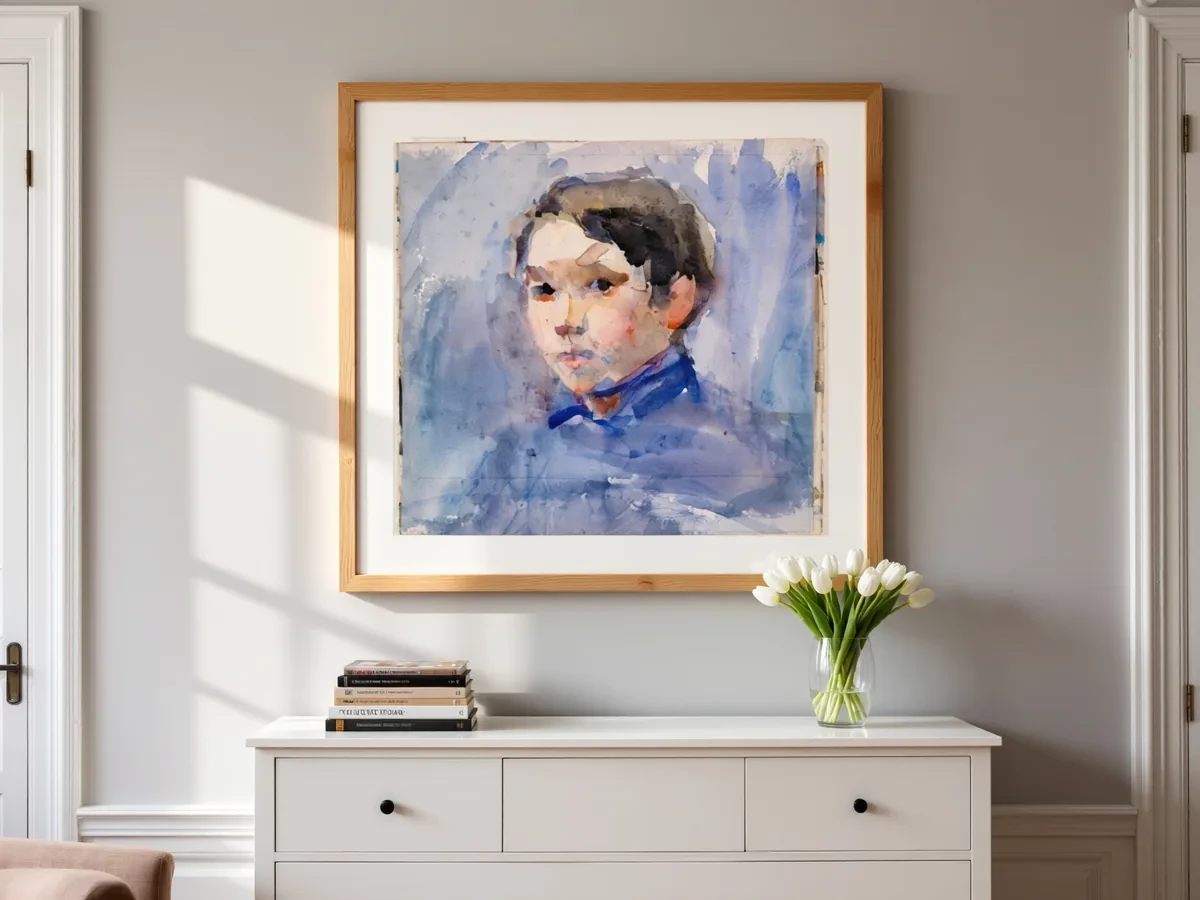
A mat is part of how you look at a picture. Around a small drawing, a wider border can give the fine lines room to settle. Around an already large print, it can turn a manageable frame into something that barely fits the wall.
About 2 inches is a reasonable place to start for a small print. From there, the work itself is a better guide than a fixed rule. A narrow and a wider version of the same picture will tell you quite a lot.
 Frameit AI Create
Original artwork: Clare Marsh
Mat width by artwork size
| Artwork size | Mat border | Approx. in cm |
|---|---|---|
| Up to 8 × 10 in | About 2 in | 5 cm |
| 11 × 14 to 16 × 20 in | 2.5 to 3 in | 6.5 to 7.5 cm |
| 18 × 24 to 24 × 36 in | 3 to 4 in | 7.5 to 10 cm |
| Larger than 24 × 36 in | 4 in or more | 10 cm or more |
Treat these as starting points rather than fixed rules:
- Small artwork can take an oversized mat on purpose. A 5 × 7 drawing in a 3- or 4-inch mat looks deliberate and formal, and it gives a small piece more presence on the wall.
- Large posters can go narrow or skip the mat. A border of 1 to 1.5 inches, or none at all, keeps a big print from turning into a huge frame.
- Check narrow and wide versions. A narrow border may feel cramped; a very wide one may make the artwork too small within the finished piece. Compare both at room distance.
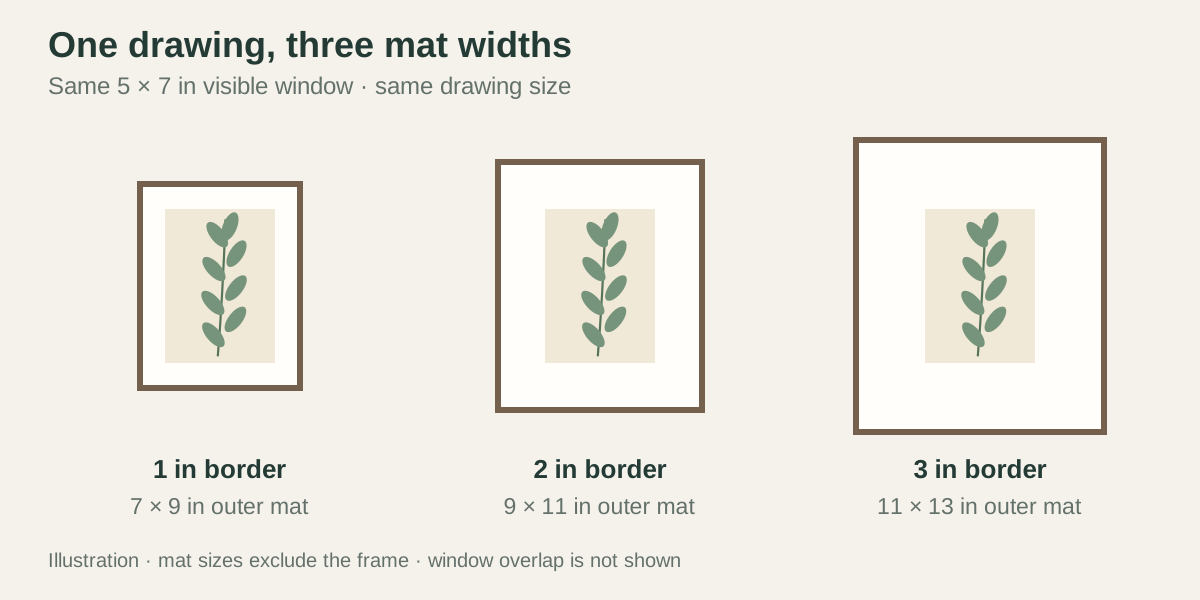
The same drawing, with a little more space
The diagram keeps a 5 × 7 inch visible window fixed and adds 1-, 2- and 3-inch mat borders. The outer mats measure 7 × 9, 9 × 11 and 11 × 13 inches, before the frame moulding. The drawing stays the same size; the surrounding space grows.
 Scale illustration
Up close, the wider version may be lovely. Across the room, the same drawing may become hard to read inside a large white rectangle. Both views belong in the decision, especially if the piece is going somewhere you usually pass rather than sit.
Keeping the frame and mat color the same makes the width comparison clearer. Once the space feels right, it is easier to decide whether the white is too bright or too warm.
How to calculate the mat window and frame size
- Measure the artwork. Note the full paper size and the image area.
- Size the window. For a mat that covers the edges, cut the window about 1/4 inch (6 mm) inside the artwork on each side, so it is 1/2 inch smaller in both directions. An 8 × 10 print gets a 7.5 × 9.5 inch window.
- Add the border. Outer mat size = window + 2 × border. Add the extra bottom amount if you’re weighting it.
- Match a frame. Round the outer size to the nearest standard frame, then adjust the border so the numbers work. Our list of standard picture frame sizes shows common mat and frame pairings.
Here is the math for an 8 × 10 print in an 11 × 14 frame:
| Item | Width | Height |
|---|---|---|
| 8 in | 10 in | |
| Window (1/4 in overlap per side) | 7.5 in | 9.5 in |
| Frame opening | 11 in | 14 in |
| Mat border | 1.75 in each side | 2.25 in top and bottom, or 2 in top and 2.5 in bottom if weighted |
If the print has a signature or edition number below the image, cut the window larger than the image area so that line stays visible. For paper with a deckled or torn edge you want to show, the artwork can be float mounted on a backing board, with the window cut larger than the whole sheet.
White has a color too
A bright white mat can make warm paper look yellower than it does on its own. Soft white or off-white is often an easier companion for cream paper, while a crisp white may suit a high-contrast photograph.
Black and charcoal give a stronger edge. A color drawn from the artwork can be interesting as the small inner reveal of a double mat. The larger that area becomes, the more it participates in the composition.
A paper sample beside the actual work is useful here. Colors that seem almost identical on a screen can be noticeably different against the sheet you are framing.
Single, double and archival mats
- A single mat is one board with one window. It’s the default for most prints and photos.
- A double mat stacks two boards, with the lower one showing as a thin reveal, typically about 1/4 inch. It adds depth and a place for an accent color. Count the reveal in your total border width.
- For originals, signed prints and photos you want to keep, ask for an acid-free or cotton rag (archival) mat and backing. Standard paper mats are fine for posters and inexpensive prints.
- Canvas paintings usually aren’t matted. They go straight into a frame or a floater frame.
If you haven’t settled on the frame yet, start with how to choose a picture frame, then come back to the mat.
Make a comparison you can take to the framer
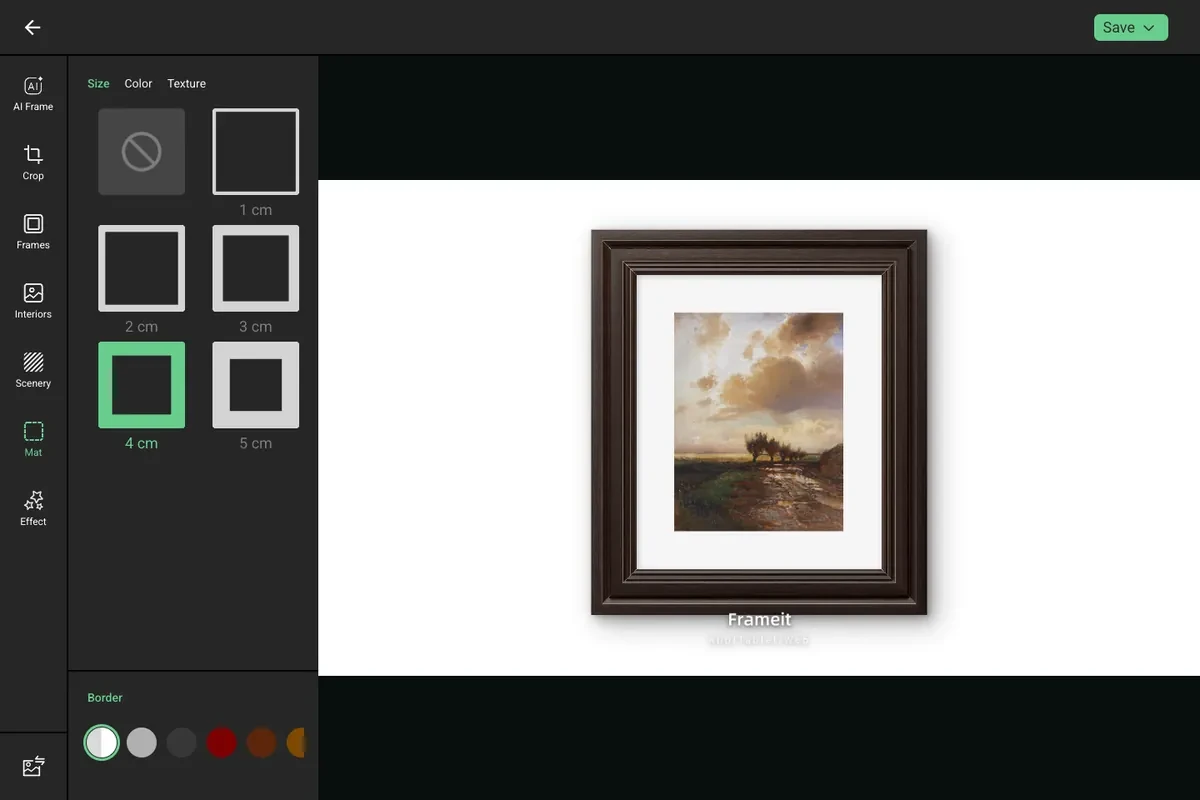
Upload the artwork to Frameit and save a narrow and a wider mat treatment in the same frame. Compare them at full image size and as small room previews.
Then try a soft white and a cooler white around the same image. Watch the paper: a bright border can make a warm sheet appear yellower. Keep the version that supports the paper and the marks you want people to notice.
Use the saved preview to explain the proportion and color you like. Give the framer the original measurements and identify signatures or deckled edges that must stay visible; the preview is not a cutting specification.
 Frameit Editor