The familiar 57-inch hanging rule measures to the center of the artwork. It works as a starting point on an open wall. Above a sofa, the gap between the furniture and the frame can matter more.
A picture can be technically at eye level and still look as though it is drifting away from the room. Before marking the hook, it helps to see the whole arrangement from the place where you will actually sit.
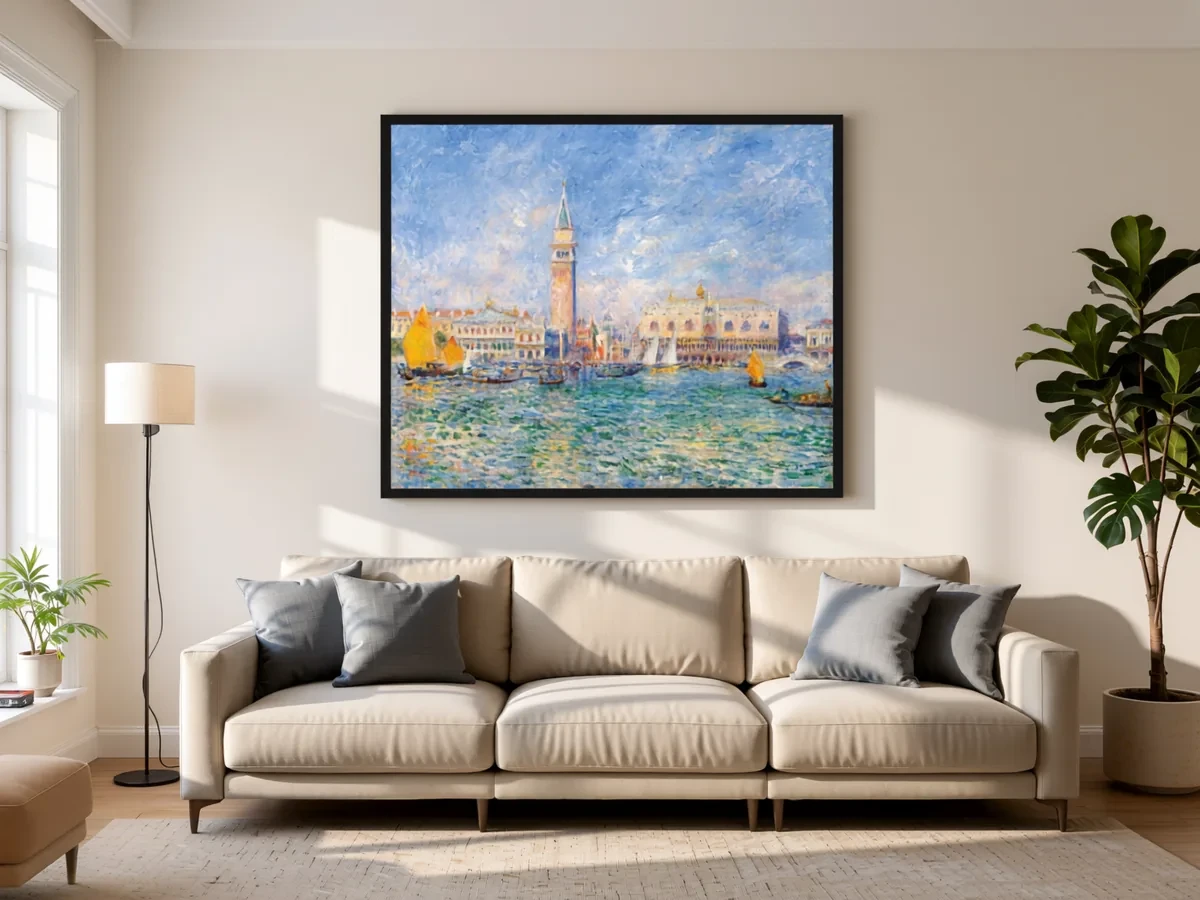 Frameit AI Create
Original artwork: Pierre-Auguste Renoir
The 57 to 60 inch rule
Many galleries and museums hang artwork so its center sits around 57 inches from the floor, and 60 inches is a common choice at home. The number always refers to the center of the artwork, not the top edge or the nail. For a group of frames, use the center of the whole group.
To turn that into a hook position:
- Measure the height of the framed artwork and divide it by two.
- Pull the hanging wire up toward the top of the frame, as it will sit on the hook, and measure from that point to the top edge. For a D-ring or sawtooth hanger, measure from the hanger to the top edge.
- Add half the height to 57 (or 60) inches, then subtract the distance from step 2.
- Mark that height on the wall and check that it lines up with the center of the space before you drill.
Example: a frame 20 inches tall whose wire pulls up to 3 inches below the top edge. The hook goes at 57 + 10 − 3 = 64 inches from the floor. The same formula works in centimeters, starting from 145 to 152 cm.
When the eye-level rule and the sofa disagree
Imagine a sofa back 34 inches high and a framed picture 20 inches tall. Placing the picture’s center at 57 inches puts its bottom at 47 inches: a 13-inch gap above the sofa.
If that makes the picture feel detached, try an 8-inch gap instead. The bottom becomes 42 inches and the center 52 inches. That is a reasonable arrangement to test in a seated room, even though it falls below the usual open-wall guideline.
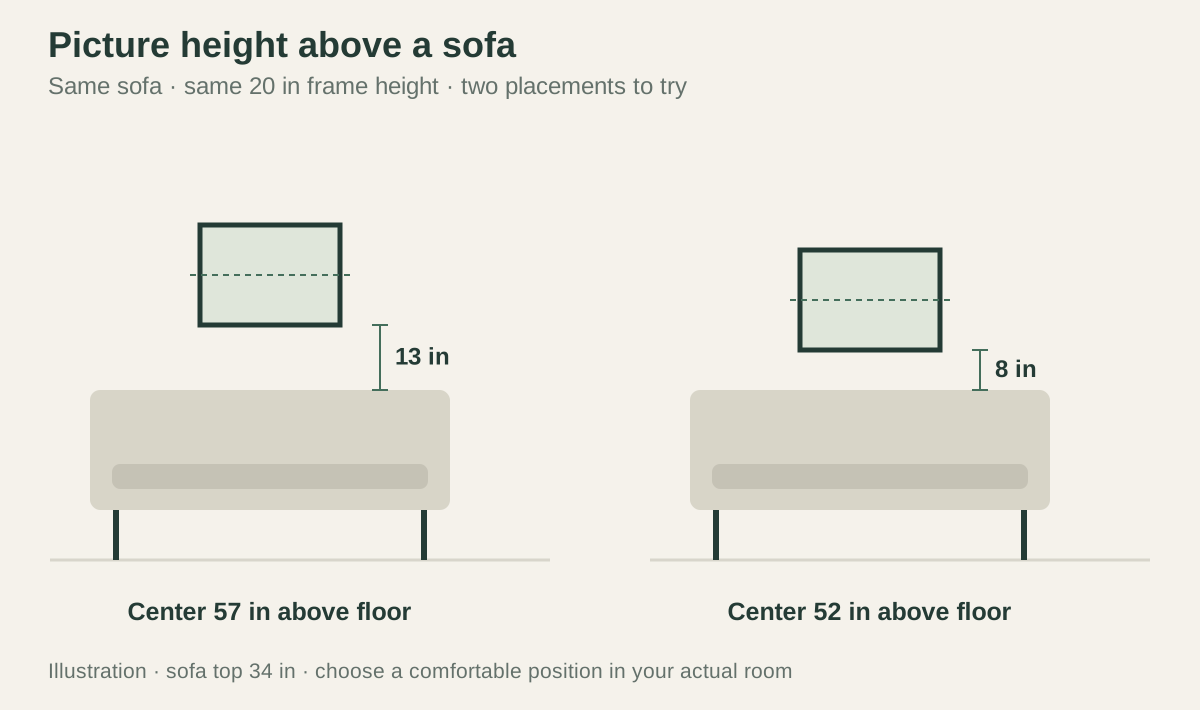 Height illustration
Use these gaps as starting points:
| Furniture | Starting gap to the bottom of the frame |
|---|---|
| Sofa | 6 to 10 in |
| Headboard | 6 to 12 in |
| Console or sideboard | 4 to 8 in |
Tape the finished outline on the wall, then look from the doorway and your normal seat. Sit back to check head clearance. If you need to raise the picture for comfort, raise it; the guideline should help you use the room.
For unusually tall furniture or very large artwork, test the complete arrangement instead of forcing both a fixed center height and a fixed gap.
What size art to hang above a couch
Try about two-thirds of the couch width, measured across the outside of the frame, then compare a smaller option. A small work may sit well with a floor lamp or neighboring shelf; the table gives proportions to test, not a minimum requirement.
| Couch width | Art width at two-thirds | Smaller option to compare (half) |
|---|---|---|
| 60 in (152 cm) | 40 in (102 cm) | 30 in (76 cm) |
| 72 in (183 cm) | 48 in (122 cm) | 36 in (91 cm) |
| 84 in (213 cm) | 56 in (142 cm) | 42 in (107 cm) |
| 96 in (244 cm) | 64 in (163 cm) | 48 in (122 cm) |
- Groups count as one piece. Two 24-inch-wide frames with a 3-inch gap measure 51 inches in total, which suits a couch of about 75 to 80 inches.
- Center on the couch, not the wall. The sofa and the artwork read as one unit, so line up their centers even if the sofa sits off-center on the wall.
- Landscape shapes suit long sofas. A single tall, narrow piece over a wide couch usually needs a partner or a horizontal group.
If you are buying a frame for a specific spot, remember that the moulding and mat add to the outside size. Our list of standard picture frame sizes shows how much.
Adjusting for ceilings, stairs and seated rooms
- High ceilings. Stay near the top of the 57 to 60 inch range rather than lifting artwork toward the ceiling. Fill extra height with a larger piece or a group instead.
- Dining rooms and offices. People mostly sit in these rooms, so the lower end of the range often feels better, as long as the gap above any sideboard still works.
- Stairs. Measure 57 to 60 inches up from the step directly below the center of each frame, so the line of artwork follows the slope of the stairs.
- Oversized artwork. A very tall canvas may need its center below 57 inches to keep some wall visible above it.
- Gallery walls. Hang the group so its overall center sits at 57 to 60 inches, or follow the furniture gap if it’s above a sofa. Spacing and layout options are in our gallery wall layout ideas.
A room view, then the real wall
A single large painting and a pair of smaller works can occupy much the same width above a sofa. They won’t necessarily feel the same: the pair introduces a gap and a rhythm, while the large piece gives you one uninterrupted image.
A Frameit preview can help you compare that overall arrangement. Once you have a preference, the taped outline brings it back to your room, your seat and the furniture you actually have.
The hook position is the last measurement. By then, you know where you want the frame; the wire or hanger simply determines how to put it there.
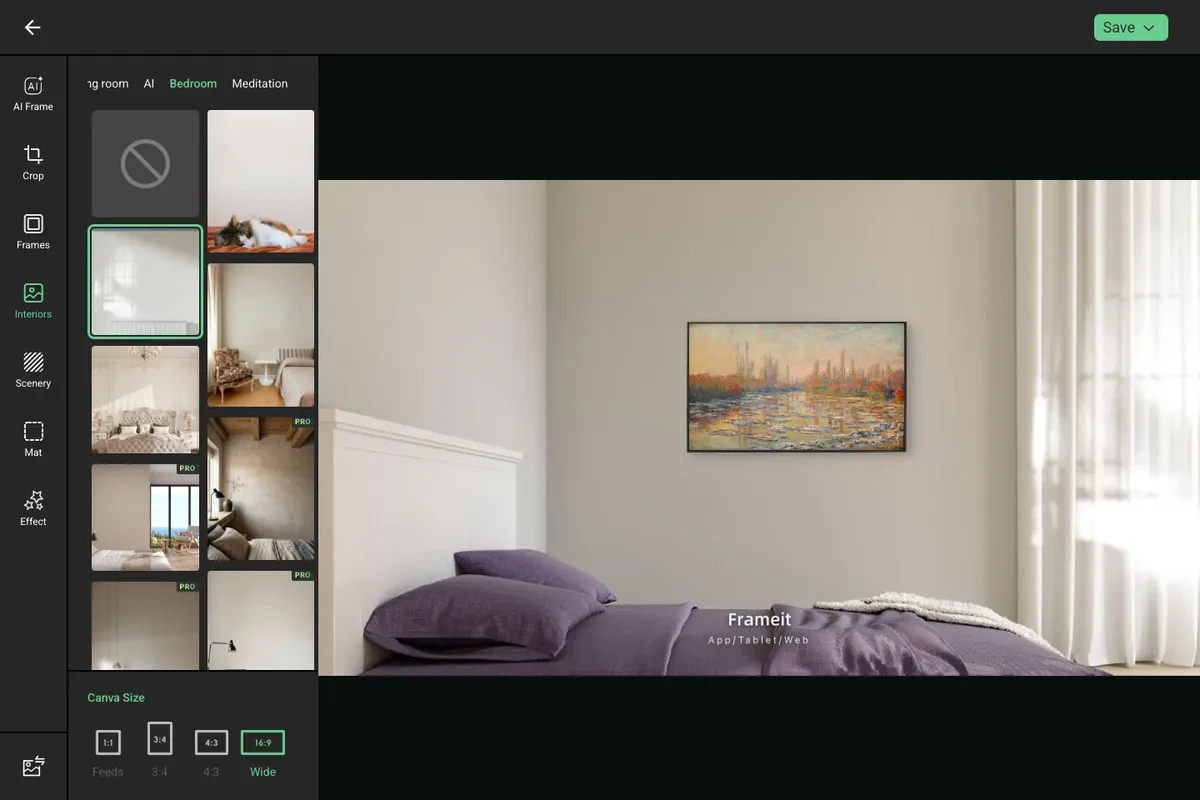 Frameit Editor